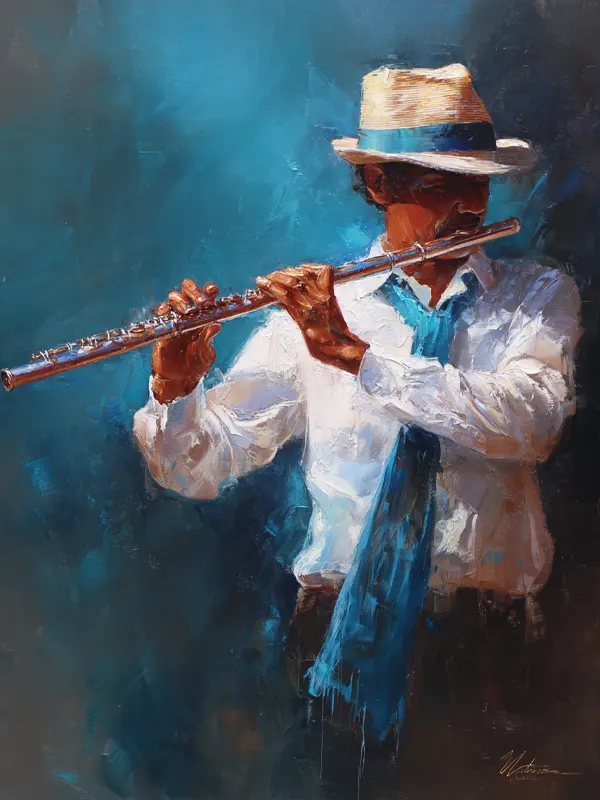
© Varrone & Romano Collection (All rights reserved).
Origins and Training
Severino Gazzelloni was born in Roccasecca on January 5, 1919, into a family of modest economic means. His father, Giuseppe, was a tailor who played the flugelhorn in the town band, and it was in this musical environment that young Severino first came into contact with music. At the age of seven, he began playing the flute almost entirely self-taught and was soon joined the local band.
The band director, Giambattista Creati, quickly recognized the boy's talent and guided him in his early musical studies, allowing him to play steadily in the ensemble until his adolescence. Later, Gazzelloni continued to perform in various provincial bands, progressively consolidating his instrumental experience.
In 1934, he moved to Rome to continue his training at the Accademia Nazionale di Santa Cecilia, where he studied flute under the guidance of Arrigo Tassinari. He completed his studies in 1942, embarking on a professional career that would lead him to become one of the most important Italian flutists of the 20th century.
The Beginnings of His Career
During the years of World War II, Gazzelloni began his musical activity by participating in various artistic experiences. He played in the rhythm-symphonic orchestra conducted by Alberto Semprini and also worked in "avanspettacolo" theater, performing at the Teatro Odescalchi in Erminio Macario's company.
In 1944, he joined the RAI Symphony Orchestra in Rome, then called the Radio Roma Orchestra and conducted by Fernando Previtali. Within this ensemble, he later became principal flute and collaborated with the orchestra for over thirty years, contributing significantly to the dissemination of the flute repertoire.
His solo career officially began in 1945 with a tour to Belgrade, while his Italian debut took place in 1947 at the Teatro Eliseo in Rome in a recital with harpist Alberto Soriani. In these years, Gazzelloni began to establish himself as one of the leading flute interpreters in Italy.
The Encounter with Contemporary Music
Thanks to the composer and conductor Bruno Maderna, Gazzelloni approached the new music of the post-World War II period. From 1952, he participated in the Darmstadt International Summer Courses for New Music, where he taught flute from 1956 to 1966.
In this context, he came into contact with some of the major protagonists of the European musical avant-garde, including Pierre Boulez, Karlheinz Stockhausen, Luigi Nono, Franco Donatoni, Olivier Messiaen, John Cage, Luciano Berio, and Sylvano Bussotti. These collaborations helped expand the instrument's modern repertoire and consolidate the flutist's international fame.
The "Golden Flute"
Thanks to his extraordinary technique and the variety of his repertoire, which ranged from classical to light and popular music, Gazzelloni quickly achieved great notoriety. His artistic personality and performance style earned him the nickname "The Golden Flute."
The nickname was also linked to the instrument he used in concerts: a gold flute specially built for him by a German craftsman and decorated at the base with a small diamond ring.
Chamber Music
In 1969, Gazzelloni founded a trio together with pianist Guido Agosti and cellist Enrico Mainardi. The ensemble represented an important chamber music experience in the flutist's career and contributed to further expanding the repertoire for flute and chamber instruments.
Collaborations and Musical Experimentations
During the 1970s, Severino Gazzelloni further expanded his repertoire, exploring different musical languages and collaborating with artists from various fields. In 1976, he held a series of concerts in Italy where he complemented the classical repertoire, performed in duo with pianist Bruno Canino, with jazz-style improvisations created with musicians such as Enrico Intra, Giancarlo Barigozzi, Sergio Farina, Pino Presti, and Tullio De Piscopo.
His commitment to contemporary music was recognized by numerous composers who wrote works dedicated to his art. Among these is the famous Sequenza for solo flute by Luciano Berio, composed specifically for him and now considered one of the most important pages of the modern repertoire for the instrument.
Final Years and Artistic Legacy
In the final years of his life, Gazzelloni continued to perform and teach, maintaining a strong influence on new generations of musicians. His last public appearance took place in 1992 during the production of a promotional film for the Brioni tailoring house, filmed at Palazzo Taverna in Rome.
He died a few months later, on November 21, 1992, in Cassino. His figure remained linked to the rediscovery and valorization of the flute as a solo instrument in the Italian musical scene.
Influence and Trivia
Gazzelloni's fame crossed the boundaries of classical music and also reached the jazz world. Indeed, musician Eric Dolphy dedicated the track Gazzelloni to him, included in the album Out to Lunch!. Among the flutist's most famous students is the Dutch musician Abbie de Quant.
Gazzelloni also appeared in a brief cameo in the film FF.SS. – Cioè: “…che mi hai portato a fare sopra a Posillipo se non mi vuoi più bene?”, playing the role of a beggar musician.
The Instruments
During the most celebrated period of his career, Gazzelloni used a gold flute specially built for him in 1956 by the American house Wm. S. Haynes. He later played several instruments of the same type made by various manufacturers, also contributing to the spread of high-level flute models in the international concert scene.
Role in the Renaissance of the Modern Flute
After World War II, Severino Gazzelloni played a decisive role in the rediscovery of the flute as a solo instrument in the Italian musical landscape. Thanks to his extraordinary technique and curiosity toward diverse repertoires, he significantly expanded the expressive possibilities of the instrument, bringing it steadily into major concert halls.
Through collaborations with contemporary composers, teaching activities, and an intense international career, Gazzelloni fostered the birth of a new flute repertoire and contributed to the training of numerous performers. For these reasons, he is today considered one of the protagonists of the flute's renaissance in the 20th century and a central figure in the history of the Italian flute school.


© Collezione Varrone & Romano (Tutti i diritti riservati).