
Origins and education
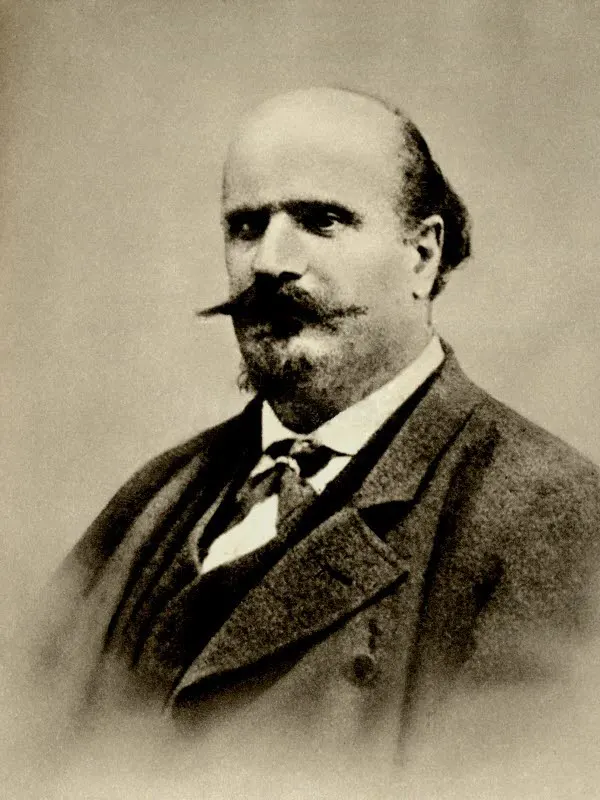
Temistocle Solera was born in Ferrara on December 25, 1815, into a progressive middle-class family. His father, Antonio Solera, a lawyer and magistrate in Iseo, was involved in the Carbonari uprisings of 1820 and arrested along with Antonio Oroboni and other patriots of the Polesine. Initially sentenced to death, his sentence was commuted to twenty years in prison, and he spent a long detention in the Spielberg fortress.
Despite these family events, Temistocle was able to study in Vienna at the Maria Theresa Imperial College, supported by the Habsburg Empire. There he received a solid musical and literary education, although he soon showed a restless and undisciplined character.
Adventurous youth and musical studies
During his formative years, Solera demonstrated a rebellious temperament. Unwilling to be educated in the country that held his father prisoner, he fled the college and joined a circus company for a period, working as an acrobat and rider.
Once captured, he was sent to complete his studies at the Collegio Longone in Milan and subsequently at the Milan Conservatory, where he studied composition, flute, and singing. In 1837, he debuted as a poet with the collection I miei primi canti, which was favorably received by critics.
Librettos and literary activity
Until 1845, Solera remained primarily in Milan, dedicating himself to literary activity. He wrote novels, poems, and especially opera librettos. His only novel, Michelina – Scena milanese del 1836, appeared in 1842.
His fame is mainly linked to his collaboration with Giuseppe Verdi, for whom he wrote the librettos of Oberto, conte di San Bonifacio (1839), Nabucco (1842), I Lombardi alla prima crociata (1843), Giovanna d’Arco (1845), and Attila (1846). In particular, Nabucco represented an enormous success and contributed decisively to the establishment of the young Verdi.
The experience in Spain
After 1845, Solera moved to Spain, where he worked as a theatrical impresario in various cities. During this period, he also composed several works, including La hermana de Pelayo, and wrote the historical poem La toma de Loiò. He also collaborated with the composer Emilio Arrieta, for whom he wrote the librettos of Ildegonda and La conquista di Granata.
In Madrid, he managed to enter court circles, becoming a counselor to Queen Isabella II. This position marked the beginning of his diplomatic career.
Political and diplomatic activity
In 1859, Solera returned to Italy at the height of the Risorgimento. Thanks to important political connections, he served as a secret courier between Napoleon III, Victor Emmanuel II, and Camillo Cavour. In 1860, he was appointed police delegate in Basilicata with the task of fighting brigandage.
Subsequently, he held the posts of questor (police chief) in Florence, Palermo, and Bologna. Later, he accepted the invitation of the Khedive of Egypt to organize the local police, moving to Cairo, where he also returned to musical composition.
Final years
With the money earned during his stay in Egypt, Solera completely changed his life and moved to Paris, where he unsuccessfully tried his hand as an art dealer and antiquarian. In his final years, he eventually returned to Milan.
He died in the Lombard city on Easter morning in 1878. The funeral took place the following day, and he was buried in the Monumental Cemetery of Milan.
Works and style
Temistocle Solera was a multifaceted figure: librettist, composer, poet, writer, and occasional conductor. Politically, he was close to the Neo-Guelph current and actively participated in the cultural and political life of Risorgimento Italy.
Beyond his collaboration with Verdi, he wrote numerous other librettos and composed some of his own operas, including Ildegonda (1840), Il contadino d’Agliate (1841), Genio e sventura (1843), and La hermana de Pelayo (1853), performed at the Gran Teatre del Liceu in Barcelona. Despite the variety of his activities, his name remains primarily linked to the librettos that contributed to the birth of Verdi's first great operas.


Pubblico dominio (Commons)
