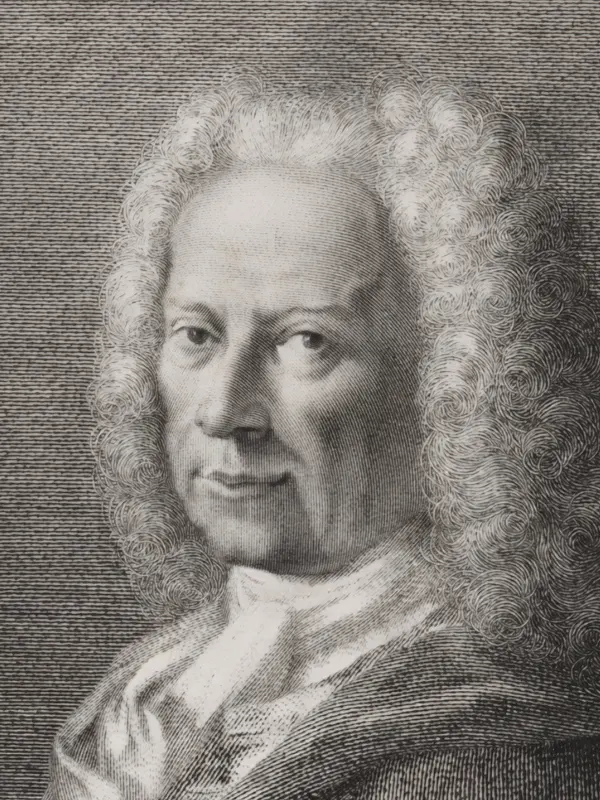

Origins and education
Scipione Francesco Maffei was born in Verona on June 1, 1675, into an aristocratic family. He was the son of Marquis Giovanni Francesco Maffei and Silvia Pellegrini, while his brother Alessandro pursued a military career, becoming a general in the Bavarian army.
Maffei received a solid education at the Jesuit colleges of Parma and Rome. In his youth, he initially followed a military career and became an officer in the Bavarian army. He also participated in the Battle of Donauwörth in 1705. After this experience, he returned to Italy, where he decided to dedicate himself to intellectual life, launching an extensive range of study and writing activities.
Scholar and reformer
Upon returning to his homeland, Maffei established himself as one of the most representative figures of early 18th-century Italian culture. A historian, scholar, and playwright, he engaged with numerous fields of knowledge and contributed to the revitalization of Italian theatre during a period of profound cultural transformation.
He also collaborated on the reform of the University of Turin at the behest of King Victor Amadeus II. His thought, characterized by an enlightened Catholicism open to reform, exerted a notable influence on Italian intellectual circles and on several reformist rulers of the 18th century.
The rediscovery of ancient manuscripts
One of Maffei's most important contributions involved the rediscovery of precious manuscripts preserved in the Chapter Library of Verona. With the help of Canon Carinelli, he identified ancient texts that had remained hidden for a long time, including the famous palimpsest codex containing the Institutes of the Roman jurist Gaius.
Among the materials recovered were two parchments of the Fragmentum de iure fisci and the folium singulare de praescriptionibus et interdictis. Maffei produced a partial transcription of these documents, publishing some extracts in his Istoria teologica, thereby contributing to the knowledge of ancient legal sources.
The Lapidary Museum of Verona
Among the most significant cultural initiatives promoted by Maffei was the founding of the Lapidary Museum of Verona, established in 1714 and considered the first lapidary museum in Europe. The institution was later reorganized by Maffei himself between 1744 and 1749 and represented an innovative model for the preservation and study of ancient epigraphs.
The museum, which today bears the name of the Veronese scholar, testifies to his commitment to the protection and enhancement of archaeological and historical heritage.
Scientific interests
Maffei did not limit his interests to the humanities. He also concerned himself with natural phenomena and scientific questions. In particular, he understood that the lightning visible to the human eye forms from the ground and then rises toward the clouds—an interpretation opposite to what was generally accepted at the time.
His role as a promoter of the sciences is also evidenced by the Lettera di un matematico italiano addressed to him by Gaetano Marzagaglia, recognizing the value of his observations and his commitment to the dissemination of scientific culture.
An enlightened Catholic
The thought of Scipione Maffei belongs to the framework of so-called enlightened Catholicism, a cultural current that sought to reconcile religious tradition with the new demands of reason and civil progress. Giacomo Leopardi defined him in the Zibaldone as a "man born noble in free, frank, unprejudiced, and original criticism," acknowledging the strength and independence of his spirit.
As a young man, Maffei undertook a long journey through Europe, which led him to know some of the continent's major cultural capitals. In 1732, he arrived in Paris, where he stayed for four years and was welcomed as a member of the Académie des Inscriptions et Belles-Lettres, coming into contact with the French intellectual environment.
The «Consiglio politico» and the critique of the Republic of Venice
At the conclusion of his European journey in 1736, Maffei wrote the Consiglio politico, a text intended for the government of the Republic of Venice. In this writing, he denounced the weakness of the Venetian State in the face of European powers and questioned the delicate political system based on the dominance of a few patrician families and the exclusion of the mainland (Terraferma) elites.
Maffei observed that this system had produced a progressive decline of the Venetian ruling class and an ineffective foreign policy masked by prudent neutrality. According to the Veronese scholar, the solution lay not in the simple co-optation of new families into the patriciate, but in a broader involvement of citizens in the life of the State, modeled on ancient Rome.
Alongside the Roman model, Maffei also looked to the English and Dutch political systems, characterized by non-absolute institutions and a significant presence of civic representation. The Consiglio politico was never officially presented to the Venetian government and was published only in 1797, shortly before the fall of the Republic. During the Risorgimento, the work enjoyed some success and may have influenced the federalist thought of Carlo Cattaneo.
Nobility, economy, and societal reform
Another important contribution by Maffei was the treatise Della scienza chiamata cavalleresca (1710), in which the scholar argued that nobility should no longer be based exclusively on lineage or military tradition, but on professional competence and service performed in the civil magistracies of the State.
In 1744, he also published Dell’impiego del denaro, a text in which he addressed the delicate issue of interest and usury. Observing the economic dynamism of England and Holland, Maffei argued that interest could be considered a legitimate gain when it compensated for the risk of investment. He sought to involve figures such as Pope Benedict XIV and Ludovico Antonio Muratori in this debate, convinced that a revision of the Church's traditional positions was necessary to favor the economic development of Catholic societies.
The fight against superstition
In the 1750s, Maffei also participated in an important cultural debate on the relationship between religion and superstition. In works such as Arte magica dileguata, Arte magica distrutta, and finally Arte magica annichilata, he argued for the incompatibility between enlightened Christianity and the persistence of magical beliefs.
His intent was to liberate European culture from superstitions, demonstrating that religious faith could coexist with rationality and the progress of scientific knowledge.
Theatre and the reform of tragedy
Maffei also engaged with theatrical theory. As early as 1700, with the Osservazioni sopra la Rodoguna, he criticized the French tragedy of Corneille, judged to be excessively artificial and distant from historical truth. His most influential text on the subject, however, was the Discorso intorno al teatro italiano, published in 1723 as an introduction to an anthology of Italian tragedies.
In this essay, Maffei argued for the necessity of a rebirth of tragedy in Italy. According to him, the stage had to free itself from the influence of opera and the commedia dell'arte, which he believed had corrupted the tragic genre. Tragedy, instead, was to have a moral and pedagogical function, be simple in structure, and use natural language.
To achieve greater naturalness, Maffei proposed eliminating rhyme while maintaining the meter, which he considered essential to serious theatre. He also criticized French theatre for its excessive reliance on amorous passion and novelistic elements, believing that tragedy should imitate truth and nature with greater fidelity.
Work as a playwright
Among Maffei's theatrical works, the most famous was the tragedy Merope (1713), inspired by classical models and considered for many decades an example to be studied and imitated. The text was published in 1730 along with other theatrical works in the volume Teatro del sig. Marchese Scipione Maffei.
He also wrote the comedy Le Cerimonie (1728) and the libretto for the opera La fida ninfa (1732), set to music by Antonio Vivaldi for the inauguration of the Teatro Filarmonico in Verona. Among his last theatrical works is the comedy Il Raguet (1747), testifying to the variety of literary interests of one of the most original intellectuals of the Italian 18th century.


Pubblico dominio (Commons)
