
Origins and youth
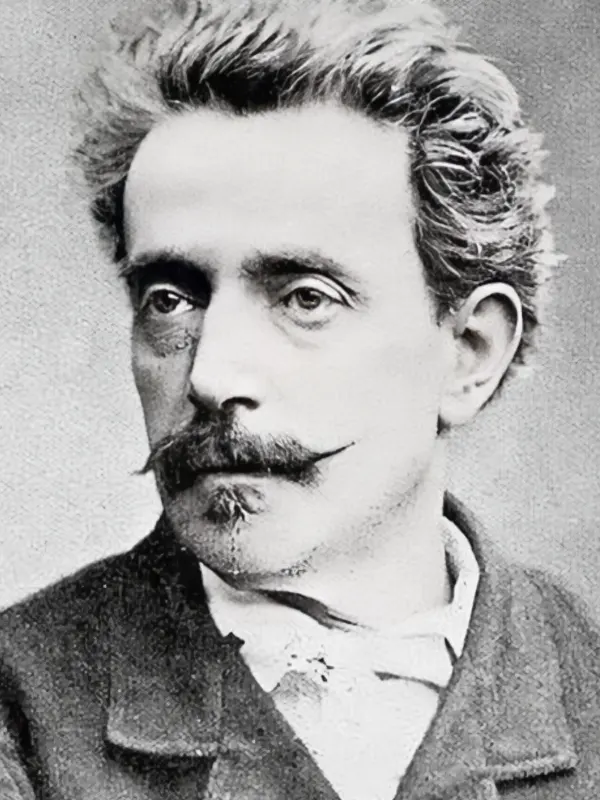
Antonio Ghislanzoni was born in Lecco on November 25, 1824. Born into a family that wanted to direct him toward an ecclesiastical career, he was initially sent to study at a seminary. However, the strict discipline of the institute proved incompatible with his lively and non-conformist character. Still a teenager, he was expelled for his irreverent behavior, an episode that helped solidify an anti-clerical attitude he would maintain throughout his life.
After completing his high school studies in Pavia, he enrolled in the faculty of medicine, but soon realized his vocation lay elsewhere. Endowed with a good baritone voice, he began studying singing and in 1846 made his debut on the operatic stage as lead baritone at the theatre in Lodi. However, this experience in the world of opera was brief: increasingly drawn to writing, Ghislanzoni soon decided to abandon his theatrical career to devote himself to literature and journalism.
Literary debut
Having left the stage, Antonio Ghislanzoni began collaborating with various magazines and newspapers. His first articles were published in Milan's Cosmorama Pittorico, a widely circulated magazine in the cultural circles of the time. It was in this periodical that his first novel, Gli artisti da teatro, appeared, in which he recounted in narrative form some of the experiences from his short period as a singer.
Writing quickly became the center of his activity. Ghislanzoni demonstrated great versatility, dedicating himself not only to fiction but also to poetry, satire, and theatrical criticism, fields in which he distinguished himself with a lively and often ironic style.
Political commitment and exile
In the agitated climate of the Italian Risorgimento, Ghislanzoni drew close to republican and Mazzinian ideas. His collaboration with politically engaged newspapers, however, exposed him to difficulties and persecution. To escape repression by the authorities, he was forced to take refuge in Switzerland, where he continued to maintain contact with democratic and patriotic circles.
Despite fleeing abroad, he was arrested by French authorities and deported to Corsica. Only after the events of the Second Italian War of Independence in 1859 could he return permanently to Italy. Having settled in Milan, he came into contact with the vibrant intellectual environment of the Scapigliatura, an artistic and literary movement that brought together writers, musicians, and artists driven by the desire to renew Italian culture.
Journalism, fiction, and opera librettos
During his long career, Antonio Ghislanzoni was extremely active in the worlds of journalism and literature. In 1857, he helped found the humorous newspaper L’Uomo di Pietra, one of the most vibrant Milanese satirical magazines. Subsequently, he directed L’Italia musicale, worked as an editor for the Gazzetta musicale di Milano, and participated in the editing of Rivista minima. After later retiring to his hometown, he also created the Giornale-Capriccio. Alongside these activities, he wrote countless articles, theatrical reviews, and cultural commentaries, as well as serialized novels and short stories published in numerous periodicals.
Among his poetic works, the 1878 Libro proibito (Forbidden Book) enjoyed great success; it went through numerous reprints and reached its seventh edition in 1890. The collection reflected the polemical and non-conformist atmosphere typical of the Scapigliata culture, while remaining more tied to satire and civil polemic than to poetic research in the strict sense.
Librettos and narrative works
Antonio Ghislanzoni was one of the most prolific librettists of the Italian 19th century. He wrote over sixty opera librettos, collaborating with various composers of his time. His name remains inextricably linked to Giuseppe Verdi's Aida, but his works also include I Lituani and Il parlatore eterno for Amilcare Ponchielli, Salvator Rosa and Fosca for Antônio Carlos Gomes, Papà Martin and Francesca da Rimini for Antonio Cagnoni, and I promessi sposi for Errico Petrella. He also wrote the verses for the cantata A Gaetano Donizetti set to music by Ponchielli.
Alongside musical theatre, he also cultivated fiction. He published the volume Reminiscenze artistiche, which contains various memories and testimonies about artists of his time, including the pianist Adolfo Fumagalli and an episode dedicated to Giuseppe Verdi's house in Sant'Agata. Among his most singular works is the novel Abrakadabra – storia dell’avvenire (1864-65), a fantasy tale with satirical and visionary elements that places him among the first Italian authors to experiment with forms of fantastic and proto-science fiction narrative.
A polemical epitaph
In the final years of his life, Antonio Ghislanzoni retired first to Barco di Maggianico and subsequently to Caprino Bergamasco, where he died in 1893 at the age of sixty-nine. He was buried in the Monumental Cemetery of Lecco. An ironic and often polemical writer, he maintained a critical spirit toward the institutions and traditions of his time until the end. Among his positions was his support for cremation, a subject on which he left several satirical and provocative verses:
«Against the system of cremation / The hypocrites protest with ire,
The Jesuits and backwards priests; / We only cremate the dead,
The Holy Inquisition / Always preferred to cremate the living.»


Pubblico dominio (Commons)
