Origins and education
Ranieri Simone Francesco Maria de’ Calzabigi was born in Livorno on December 23, 1714, to Giovan Domenico de’ Calzabigi and Maria Eleonora Vannuccini. His family initially directed him toward commercial activities so that he could assist his father in business.
Parallel to his family commitments, he cultivated a solid cultural education. He likely studied in Livorno for literary studies and in Pisa for scientific ones. Under the pseudonym Liburno Drepanio, he became a member of the Etruscan Academy of Cortona and the Academy of Arcadia, environments in which his literary vocation matured.
Naples and the Parisian experience
In 1743, Calzabigi entered the service of a ministry in Naples, a city where he began to dedicate himself to writing librettos. However, his involvement in a trial for poisoning forced him to leave the city and move to Paris.
In the French capital, he met Giacomo Casanova, with whom he established a close friendship and undertook several economic initiatives, including the organization of a lottery. During these years, he wrote the satirical poem La Lulliade, o i buffi italiani scacciati di Parigi, a critique of French court music dominated by Jean-Baptiste Lully and Jean-Philippe Rameau, linked to the cultural debate known as the Querelle des Bouffons. The text remained unpublished for a long time and was only published in 1977.
Vienna and the reform of melodrama
After leaving France, Calzabigi moved to Vienna in 1761, where he obtained administrative roles at the imperial court. He became a counselor at the Chamber of Accounts of the Netherlands and later a counselor to the Emperor of Austria.
Thanks to the mediation of Count Giacomo Durazzo, director of the court theatre, he came into contact with the composer Christoph Willibald Gluck and the choreographer Gasparo Angiolini. From this collaboration, three fundamental librettos for the history of opera were born: Orfeo ed Euridice (1762), Alceste (1767), and Paride ed Elena (1770).
With these works, Calzabigi contributed decisively to the so-called reform of Gluckian melodrama, which aimed to simplify the structure of the opera, reduce virtuosity for its own sake, and restore centrality to the dramatic action.
Final years between Pisa and Naples
Following a scandal, Calzabigi was forced to leave Vienna by order of Empress Maria Theresa. In 1774, he settled in Pisa and later, in 1780, moved to Naples, where he spent the last years of his life.
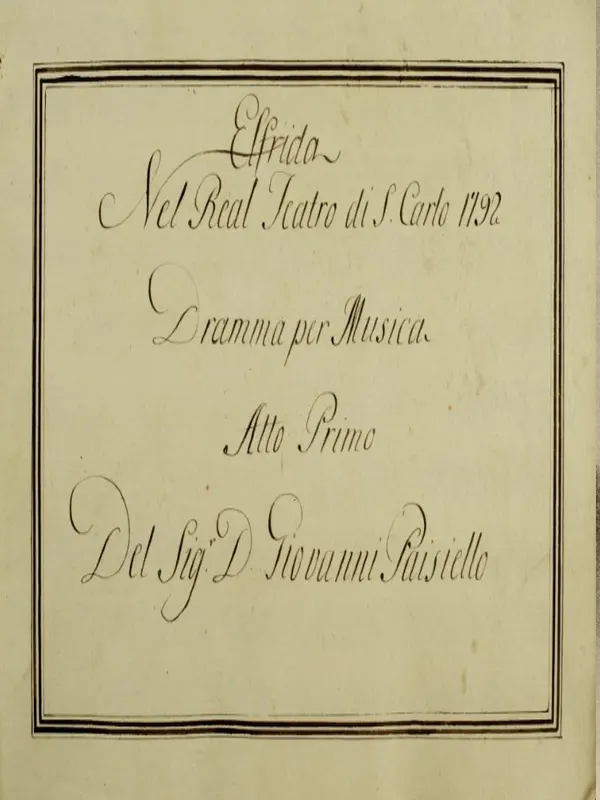
In the Neapolitan capital, he continued his literary activity and wrote his last librettos: Elfrida (1792) and Elvira (1794), both set to music by Giovanni Paisiello. During these years, he was also visited by Vittorio Alfieri, who held him in high esteem and recognized in his works an important contribution to the renewal of Italian theatre.
A reformer of musical theatre
Ranieri de’ Calzabigi was one of the most influential librettists of the European 18th century. His name is primarily linked to the reform of melodrama promoted alongside Gluck, which sought to restore dramatic coherence to opera seria by limiting spectacular conventions and excessive vocal virtuosity.
According to various accounts, Calzabigi was part of the Freemasonry and operated in cultural circles where Enlightenment ideas and projects for artistic reform intertwined. He died in Naples in July 1795, after a long life spent between literature, music, and cultural diplomacy.


Pubblico dominio (Commons)
